
ColdStream 2026.07
Release Highlights
Introduction
ColdStream 2026.07 focuses on improving the quality, performance and reliability of optimization workflows. This release delivers significant improvements in constraint satisfaction, optimization convergence and optimization reliability, helping engineers obtain high-quality designs more efficiently and with greater confidence.
Improved Constraint Satisfaction
Optimization algorithms have been enhanced to improve how engineering constraints are satisfied throughout the optimization process.
Customer Value
- Optimization constraints converge more consistently towards their specified target values.
- Final designs are more likely to satisfy the engineering requirements specified by the user.
- Constraint histories provide clearer visibility into the optimization process.
Faster Optimization Convergence
Several algorithmic improvements reduce the time required to reach a converged optimization solution. Representative industrial optimization studies have demonstrated up to a 10× reduction in optimization time, with typical optimization studies completing within an overnight run. The migration to our new compute cluster provides an additional performance improvement, with initial testing indicating up to a further 60% speed-up, amounting to overall 18× faster end-to-end.
Customer Value
- Faster optimization studies.
- Reduced computational cost.
- Quicker evaluation of design alternatives.
Improved Optimization Reliability
Numerous improvements have been made throughout the optimization framework to increase the consistency and reliability of optimization results across a broader range of optimization problems.
Customer Value
- Increased confidence in optimization results.
- More consistent optimization behavior across a wider range of design problems.
- Improved agreement between optimization objectives and the intended engineering design
requirements.
Evidence demonstrated in reference case – Collector
The improvements introduced in ColdStream 2026.07 are demonstrated using the Collector reference case. The Collector reference case consists of a laminar Conjugate Heat Transfer (CHT) simulation modeling heat transfer between a solid domain and a fluid region exposed to a high heat flux. The optimization objective is to minimize the heated wall temperature while maintaining a specified inlet pressure loss under CNC manufacturing constraints.
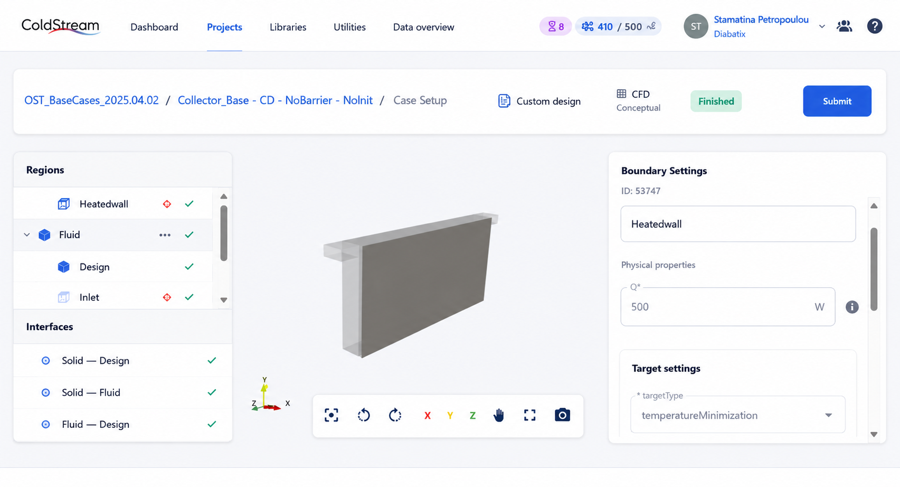
Figure 1: Case setup in ColdStream
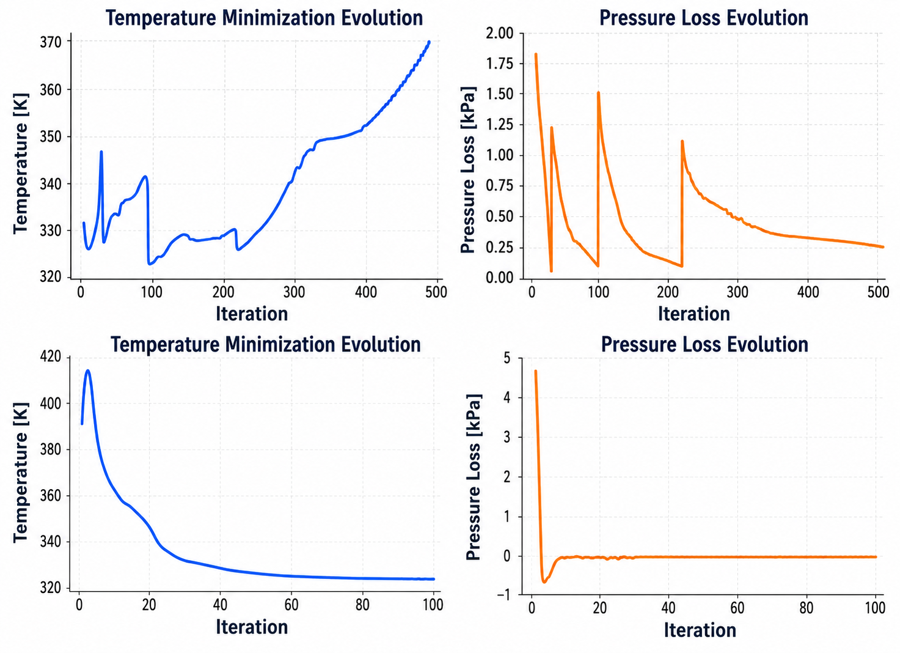
Figure 2 – Objective (left) and constraint (right) convergence before (top) and after 2026.07 (bottom)
Comparison of optimization constraint histories demonstrating improved convergence towards the specified target values.
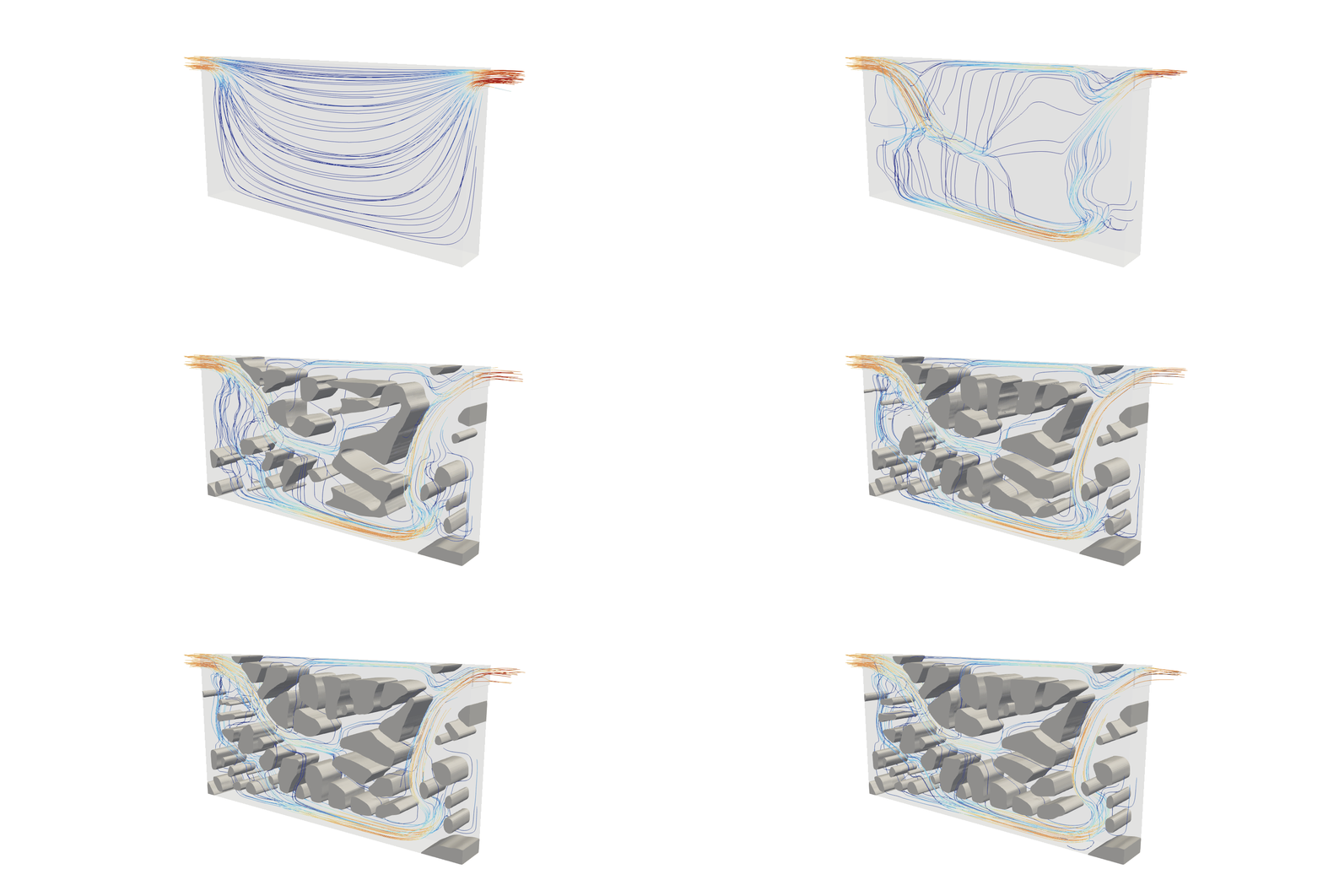
Figure 3 - Exported geometry from version 2026.07
The Collector reference case demonstrates improved optimization reliability through smoother objective convergence and higher-quality resulting geometries. The exported geometry exhibits continuous flow channels and well-defined solid islands, resulting in a cleaner and more manufacturable design.
| Configuration | Runtime | Speed-up Vs. Previous release |
|---|---|---|
| Previous production release | 75:52:20 | Baseline |
| 2026.07 - Previous cluster | 6:51:46 | ~11.1x faster |
| 2026.07 - New cluster | 4:11:53 | ~18.1x faster |
Table 1 – Cluster Performance Comparison, ~18× faster end-to-end
The Collector reference case completed in just 4 hours, representing more than an 18× reduction in optimization time compared to the previous release. This improvement was achieved through a combination of algorithmic enhancements and significantly faster optimization convergence, requiring approximately 100 optimization cycles instead of 500 as well as an extra ~1.64× speed- up from migration to a new cluster.
Updated 27 days ago